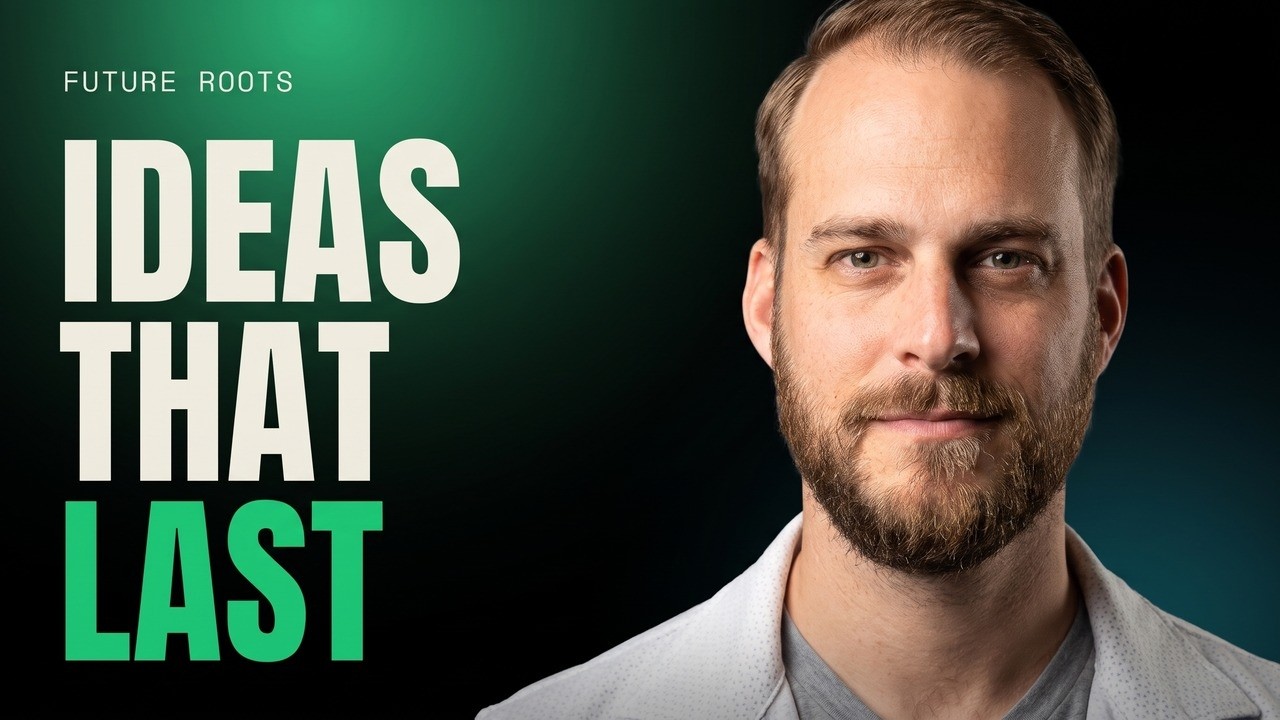
Future Roots · Conversation with Ian Peterman

Ian Peterman on Designing Products That Pay for Themselves

Ian Peterman · Founder, Peterman Design Firm

Watch on YouTubeListen on Spotify
Ian Peterman on Future Roots

Ian Peterman explains how Peterman Design Firm takes an idea end to end, from a six to eight week discovery phase to a product on a shelf that makes money, so the founder can keep solving the problem. He describes the firm's conscious design philosophy, why it guarantees clients at least two market directions, and why proving a prototype makes a patent far easier to license.

He makes the case that sustainable and efficient are the same thing in engineering terms, and walks through a jerry can style battery system, solar panels that blend into tile roofs, and why new products get adopted faster when they copy the behavior people already know. He closes on how a venture studio can help hardware founders cross the valley of death with a real team and a clean cap table, and how the firm uses AI for research but never for concepting.

In Ian's words

“They have a really good solution, but they didn't figure out how to make it profitable. So they can't keep solving the problem. The solution disappears if it's not profitable.”

Ian Peterman · 03:04

“In engineering terms, sustainable and efficient are the same thing.”

Ian Peterman · 16:17

“If you look at how technology is adopted, usually if there's multiple ones, the one that's closer to the old technology it's replacing in behavior, not technology wise, but in behavior of use, that's the one that gets adopted the most because there's less adoption friction.”

Ian Peterman · 27:36

Key takeaways

  1. A product only keeps solving its problem if it is profitable, so pricing, cost and market fit belong in the design process from day one.
  2. If a market will only pay $50 for a product that costs $75 to make, the answer is a different market, not a weaker product.
  3. In engineering terms, sustainable and efficient are the same thing: count waste as money and sell it as someone else's raw material.
  4. The technology that wins is usually the one closest in behavior to what it replaces, because there is less adoption friction.
  5. Hardware founders need a real team of specialists, and a venture studio can provide one without crowding the cap table.

Chapters

Questions people ask

What is Peterman Design Firm?
Peterman Design Firm is an end to end product development firm. Ian Peterman says it takes an idea, with or without a patent, and turns it into a product that can go on a shelf and a business that pays for itself. Every project starts with a six to eight week discovery phase covering price, cost, regulation, IP and the target market, and the firm guarantees at least two directions to market.
What is conscious design?
Conscious design is the design philosophy Ian Peterman uses at his firm and wrote a book about with his wife. It weighs environmental impact, the people involved and profitability, with the aim of making products people want, keep buying and will not regret in 10 years. He says a core part of it is designing for circularity.
Does sustainable design have to cost more?
Ian Peterman says no, and calls the idea that sustainable must be more expensive a misnomer. In engineering terms, he says, sustainable and efficient are the same thing. Not every product should biodegrade, but every process creates leftover material, and counting that waste as money, or selling it as someone else's raw material, cuts cost and material use at the same time.
Why is hardware harder to fund than software?
Ian Peterman says software can launch a mediocre beta and improve, while a hardware product that fails the first time can burn the brand, as early quality issues did for Kia in the US. Large VCs see hardware as risky and capital intensive, and a solo hardware founder has to cover around 30 specialized roles. He says a venture studio bridges that gap by taking a little cash and equity, providing fractional experts such as a CFO for a few hours, and keeping the cap table clean.
How does Peterman Design Firm use AI?
Ian Peterman says the firm uses AI for market research, data analysis, simulations, scripts, rendering and copy editing, and verifies everything. It never uses AI for concepting, because its products have to be patentable and a human has to come up with the idea. The firm still builds editable CAD models so designs are ready for production.

More conversations

Be a guest

Building what's next? Tell your story on Future Roots.

Forty-minute conversations with the investors, founders and leaders building the next twenty years.

Apply to be a guest