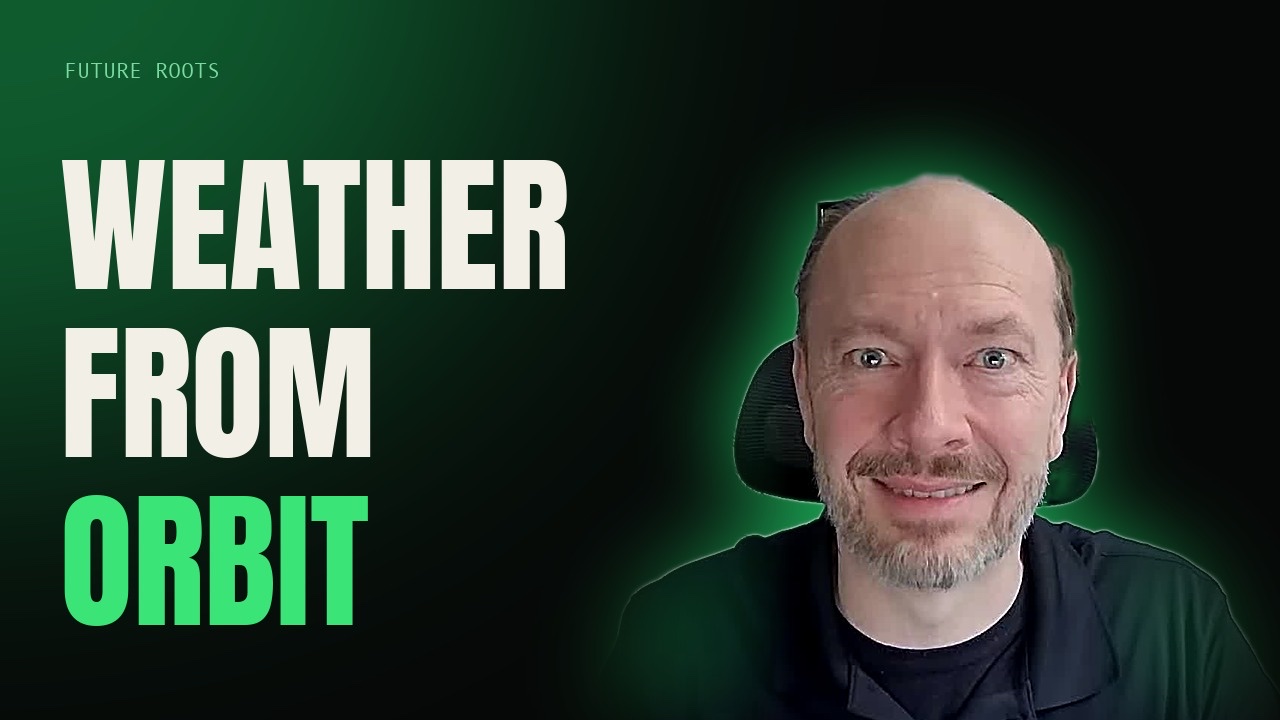
Future Roots · Conversation with Jason Derleth

Jason Derleth on Small Satellites That Work as One

Jason Derleth · Founder & CEO, Weatherwave Space

Watch on YouTube
Jason Derleth on Future Roots

Jason Derleth founded Weatherwave Space to fill the gap between government weather satellites that cost over $3 billion each and tiny CubeSats that can carry only one or two instruments. Weatherwave plans to fly clusters it calls courts: a larger central spacecraft, the empress, carrying an active instrument like radar, surrounded by 12U sentinels with passive instruments, all flying in formation and calibrating against each other so the group performs like one large satellite.

He explains how new space companies get paid by keeping ownership of their spacecraft and selling data to agencies like NOAA, NASA and the NRO on multi-year contracts, and why cost-plus contracts reward going slow. He also covers his path from philosophy and cello-making to MIT, JPL, NASA Headquarters and NIAC, an $850 million government data market he sees growing, fire alerts and disaster imagery for first responders, why weather forecasts will never reach much past two weeks, and why efficiency is what drives him.

In Jason's words

“If you're getting 70% of a $3 billion satellite's measurements with a system that costs $20 or $25 million, by golly, that's a better mousetrap, and the world may beat a path to your door.”

Jason Derleth · 29:24

“We could make more science if we just made the same spacecraft 30 times and launched it to look down at the Earth. And then we get 30 different points of view.”

Jason Derleth · 41:05

“Be excited about what you do. And efficiency gets us more of that.”

Jason Derleth · 41:31

Key takeaways

  1. Big government weather satellites now cost over $3 billion each, while CubeSats are cheap but can fit only one or two small instruments. Weatherwave aims for the space in between.
  2. A court is a cluster, not a constellation: one larger empress spacecraft with an active instrument like radar, flown in formation with smaller sentinels carrying passive instruments.
  3. Flying instruments in pairs and quads lets them calibrate against each other, building years of cross-calibrated data about the Earth and its atmosphere.
  4. The business model is to own the spacecraft and sell the data on multi-year contracts, rather than build satellites on cost-plus terms, where the incentives reward working slowly.
  5. If a system delivers 70% of a $3 billion satellite's measurements for $20 or $25 million, Jason sees a viable business in weather alone, with farming, insurance and fire alerts as further markets.

Chapters

Questions people ask

What is Weatherwave Space?
Weatherwave Space is a company founded by former NASA technologist Jason Derleth to fly clusters of small satellites, which he calls courts, for weather and Earth sensing. Each court pairs a larger central spacecraft with an active instrument like radar with smaller 12U satellites carrying passive instruments, so the group can perform like a much larger satellite at a fraction of the cost.
What is a Weatherwave court?
A court is a cluster of satellites flying close together in formation. The central spacecraft, the empress, is roughly the size of a small dorm refrigerator and has the power, volume and thermal control for an active instrument such as radar. The smaller sentinels around her carry passive instruments like millimeter wave sounders, passive radar receivers or cameras. Jason's full court is 18 satellites working together.
Who is Jason Derleth?
Jason Derleth is the founder and CEO of Weatherwave Space. He worked at NASA's Jet Propulsion Laboratory for about five years and at NASA Headquarters for about 14, where he ran the NASA Innovative Advanced Concepts (NIAC) program and part of NASA's SBIR program, then spent three years at Goddard on space telescope technology. He has a philosophy degree from St. John's College and studied aero-astro engineering at MIT.
How do small satellite companies make money from weather data?
Jason explains that new space companies usually keep ownership of their spacecraft and sell the data, often on multi-year contracts with agencies like NOAA, NASA and the NRO. NOAA spends about $30 million a year buying weather data, and he puts total government spending on data from small and medium companies at about $850 million a year. Farmers, insurers and local governments are further potential buyers.
Will weather ever be predictable more than two weeks out?
Jason does not think so. He says forecasts will never reach much beyond two weeks, and even that will be rough, because too many random things happen and space weather also interacts with the atmosphere. What enough satellite data could allow, he says, is a full state model of the atmosphere that makes forecasts within that window more accurate.

More conversations

Be a guest

Building what's next? Tell your story on Future Roots.

Forty-minute conversations with the investors, founders and leaders building the next twenty years.

Apply to be a guest