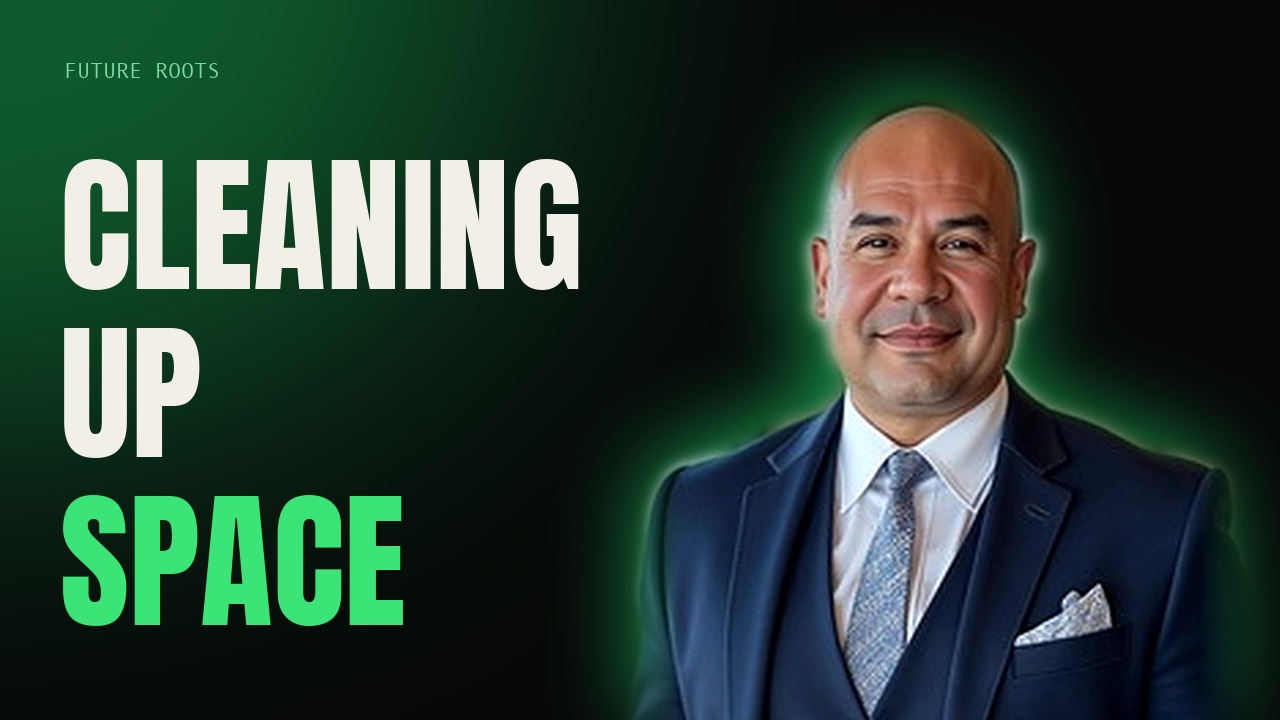
Future Roots · Conversation with Joe Guzman

Joe Guzman on Keeping Orbit Open for Everyone

Joe Guzman · Founder & CEO, Space Cowboy ADR

Watch on YouTube
Joe Guzman on Future Roots

Joe Guzman spent his early career as an Army orbital analyst protecting national security satellites from debris, and finished it in the Pentagon as the main space operations officer on the Army staff. When he looked at the problem again in 2021 and 2022, active satellites had grown from about 1,200 to about 10,000, and he learned there are more than a million pieces of lethal non-trackable debris, objects of one to 10 centimeters that no one can see or steer around.

Through Space Cowboy ADR he is focused on active debris remediation: finding those small objects and removing them with a reusable capture can that keeps the cost per capture falling. His first product, Sentinel Protocol, lets satellite operators and insurers fly a satellite or constellation through a model of 1.5 million debris objects and get a report on the risk they carry, with multi-vendor simulations for mitigation coming next.

In Joe's words

“There's this vision of things that I really want to do, like I want to sweep up space debris to make space a safe and sustainable place for all humanity.”

Joe Guzman · 05:42

“The main design problem for ADR is reducing the cost per capture. That's the one metric that really matters.”

Joe Guzman · 23:10

“In the future of space, you might have to go into space and remove debris to carve out an altitude that's safe for your constellation to operate.”

Joe Guzman · 36:52

Key takeaways

  1. Hold the long-term vision and the short-term revenue at once: Joe's vision is to sweep up space debris, but each step has to create value for a customer now.
  2. Risk is more than probability. It is also consequences, and moving a satellite costs lifetime, mission time and people, a trade he rarely saw anyone measure.
  3. The biggest blind spot in orbit is lethal non-trackable debris: more than a million objects of one to 10 centimeters in low Earth orbit that cannot be tracked or avoided.
  4. The one metric that matters in debris removal is cost per capture, so Space Cowboy avoids consumables like nets and harpoons in favor of a reusable capture can.
  5. Future constellations may have to prepare their orbit before they launch, the way a factory site gets bulldozed before it is built.

Chapters

Questions people ask

What is Space Cowboy ADR?
Space Cowboy ADR is the company Joe Guzman founded to work on active debris remediation, or ADR, the cleanup of junk in orbit. It focuses on lethal non-trackable debris, objects between one and 10 centimeters in low Earth orbit. Its first product is Sentinel Protocol, a tool that estimates how much debris risk a satellite or constellation is operating in.
What is lethal non-trackable space debris?
Joe Guzman describes it as debris between one and 10 centimeters, roughly the size of a softball or a coffee cup, that is big enough to destroy a satellite but too small to track. He says estimates put it at 1 million to 1.5 million objects in low Earth orbit. Because operators do not know where these objects are, they cannot maneuver around them.
How does Space Cowboy plan to remove space debris?
Joe plans autonomous spacecraft, likely working in pairs with one observing and one doing the work, that find small debris with sensors and fly close to collect it. The concept is a capture can, like an inverted trash can on the spacecraft, that engulfs a piece of debris, closes its doors and repeats. Collected debris would go to recyclers or be deorbited to burn up in the atmosphere.
What is Sentinel Protocol?
Sentinel Protocol is Space Cowboy's risk tool and first product. Joe built an environment of 1.5 million pieces of debris where an operator can fly a satellite or constellation, enter details like size and cost, and get a report on how much risk it faces in its orbit. He sees satellite owner operators and space insurance providers as users, and access is available through spacecowboy.today.
What was Joe Guzman's military background?
Joe Guzman went to the military academy, interned at the National Security Agency working on satellite communication cross-links, and served about eight years as a field artillery officer before moving into Army space operations. He worked as an orbital analyst doing space flight safety support for national satellites between 2003 and 2006. He ended his career at the Pentagon as the main space operations officer on the Army staff, advising the Secretary of the Army and the Chief.

More conversations

Be a guest

Building what's next? Tell your story on Future Roots.

Forty-minute conversations with the investors, founders and leaders building the next twenty years.

Apply to be a guest