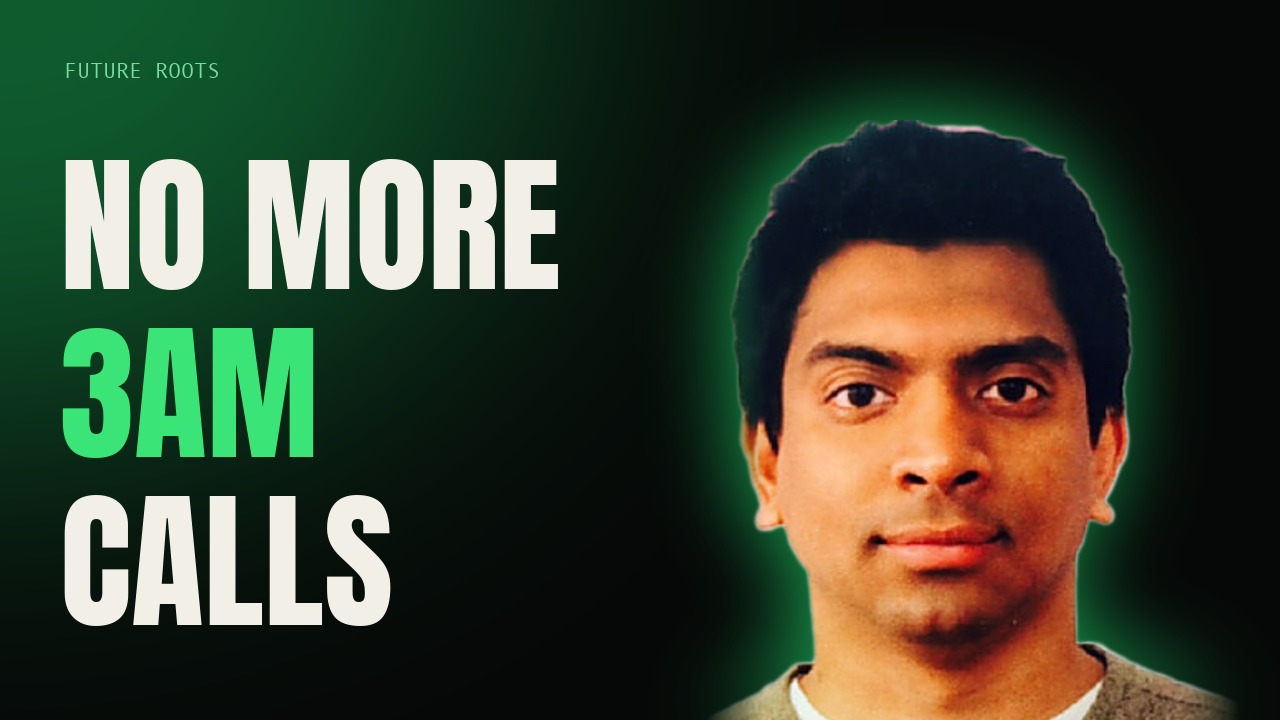
Future Roots · Conversation with Riasat Ullah

Riasat Ullah on Building the On-Call Tool He Needed

Riasat Ullah · Founder, TaskCall

Watch on YouTube
Riasat Ullah on Future Roots

Riasat Ullah ran overnight international operations at a New York hedge fund trading about $5 billion a day, where a missed hedge order on Asian index futures left the firm unhedged. PagerDuty, the tool the team used, had no escalation policy for manual tasks like his, so he built his own. That tool became TaskCall, an incident response and management system for IT and DevOps teams that now has customers in 71 countries, mostly in the US, and that his team still uses to run its own systems.

He also talks about co-founding an invoice financing firm in Kenya that lent to produce buyers rather than farmers, why he moved to Madrid in 2018 to build TaskCall, and rewriting the system five times over three years before launching in April 2021. He explains why he keeps AI out of TaskCall's core code but has seen it help junior engineers write meaningful code, how AI has made B2B marketing harder, why staying bootstrapped lets the team build for value rather than numbers, and why a success story could matter for founders in Bangladesh.

In Riasat's words

“First you have a problem, then you have an idea, then you have a product, and then you have a business. Which is a more natural trajectory of how things can go.”

Riasat Ullah · 04:47

“Resources don't just mean money. Resources are also your time. And that's in fact the biggest thing: time is more important than money.”

Riasat Ullah · 24:49

“I would rather fail trying than not ever try at all and feel like, oh, you know, I should have done that. That's what really drives me.”

Riasat Ullah · 37:31

Key takeaways

  1. Problem first: TaskCall came from a missed hedge order that PagerDuty could not escalate. First a problem, then an idea, then a product, then a business.
  2. Response time is the job: TaskCall takes alerts from tools like Datadog, New Relic and Amazon CloudWatch and automates the steps around them, so work that took up to 30 minutes gets done in a minute or less.
  3. Time is a bigger constraint than money for a solo founder, who has to choose every day between fixing things for existing clients and finding new ones.
  4. Use AI where it is safe: Riasat keeps it out of TaskCall's REST servers and core application over code quality and security, but it now helps junior engineers ship meaningful code.
  5. Being bootstrapped means no board pushing for numbers, so the team can look for what is truly different instead of copying the chat agents competitors are adding.

Chapters

Questions people ask

What is TaskCall?
TaskCall is an incident response and management system for IT and DevOps teams, founded by Riasat Ullah. When monitoring tools such as Datadog, New Relic or Amazon CloudWatch raise an alert, TaskCall makes sure the right people know, notifies stakeholders and automates the manual steps so issues get resolved faster. Its customers are in 71 countries, mostly in the US.
How did Riasat Ullah start TaskCall?
He worked overnight operations for Europe and Asia at a New York hedge fund and had to place hedge orders on Asian index futures by hand. PagerDuty, the tool the firm used, had no escalation policy for manual tasks like that, and a missed order left the firm unhedged. He built a tool to cover it, realised it could be much bigger and scaled it into TaskCall.
How long did it take to build TaskCall?
Riasat started building in April 2018 and launched in April 2021, three years later. He rewrote the system five times before launch, working mostly alone and bootstrapped. He says he never asked anyone for help on TaskCall and figured every problem out himself.
How does TaskCall use AI in its software development?
Riasat still codes himself and uses AI roughly the way he once used Stack Overflow. The team uses it to redesign client-facing web applications but keeps it out of the REST servers and core application, because of code quality, possible security holes and the access it would need. He has seen it help junior engineers write meaningful code.
Why did Riasat Ullah build TaskCall in Madrid?
He was in the US on a work visa, and setting up a company there would have needed an entrepreneurial visa backed by big VCs and financial commitments he was not willing to make. Since the West is the best place to sell software, he chose Europe, and Madrid in particular for personal reasons. He finds Madrid's startup community vibrant and helpful.

More conversations

Be a guest

Building what's next? Tell your story on Future Roots.

Forty-minute conversations with the investors, founders and leaders building the next twenty years.

Apply to be a guest