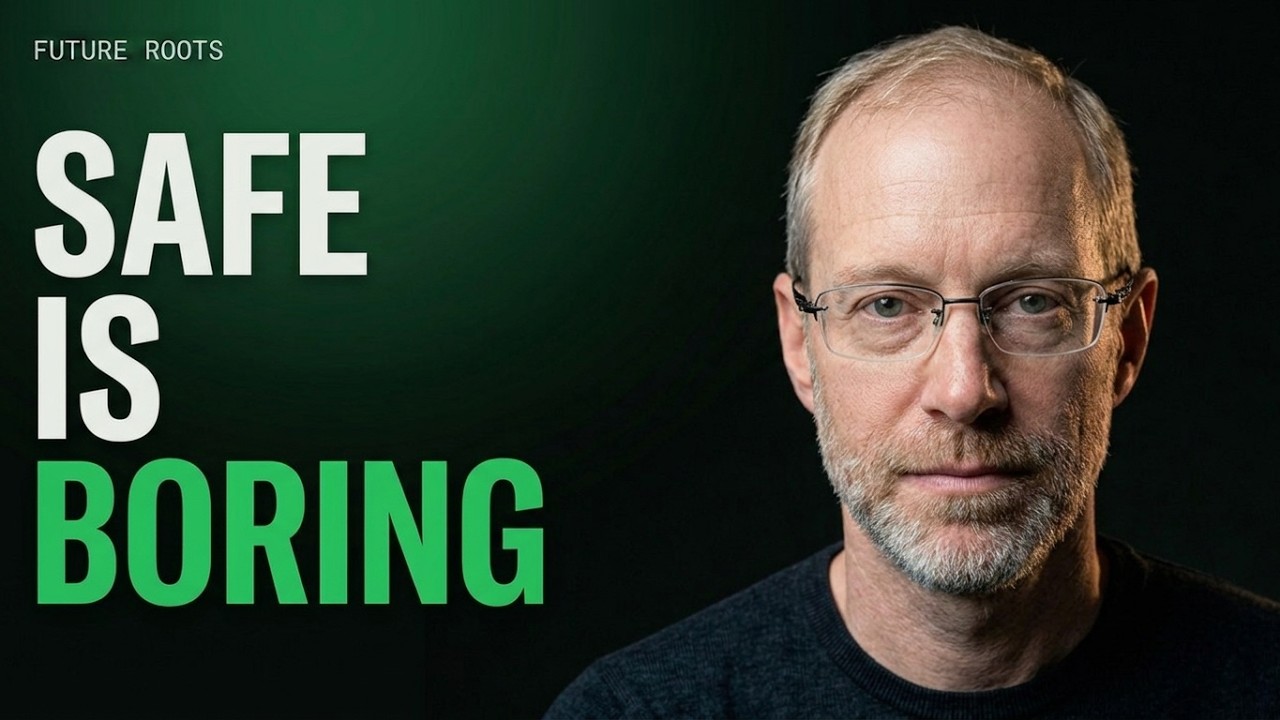
Future Roots · Conversation with Guillaume Binet

Guillaume Binet on Making Robots Replayable and Boringly Safe

Guillaume Binet · Founder, Copper Robotics

Watch on YouTube
Guillaume Binet on Future Roots

Guillaume Binet, founder of Copper Robotics, explains why today's humanoid and autonomous robots look like early self-driving cars: impressive demos, but a long road to a stable product. He describes how modern end-to-end AI models are highly capable yet opaque, which makes it hard to know the limits of what a robot can safely do.

He then walks through Copper, an open-source operating system for robots that records what a machine saw and did and replays it exactly, so an edge case can be tested over and over. He also shares what he learned at Uber ATG, Argo AI and Motional, how Copper's customers use it, and why he sees a ride so safe it is boring as the real sign of success.

In Guillaume's words

“Safe is boring. When you go to a Waymo, when you go in a Waymo car and you ask for your ride and you go through your ride, it's the most boring thing ever. And that's for me, that's the sign of success.”

Guillaume Binet · 36:51

“A robot is really like a physical device that observes the world, reasons about the world and then acts upon the world.”

Guillaume Binet · 30:00

“Copper just assures you that at the boundary of what your code is seeing or your algorithm is seeing, we can actually really replicate what was executed when and how.”

Guillaume Binet · 09:34

Key takeaways

  1. Modern end-to-end AI models give robots impressive capability but are opaque, so the hard problem is knowing a robot's operational domain and its limits.
  2. Copper records what a robot actually did and replays it deterministically on a workstation or in the cloud, so an edge case becomes evidence that can be tested again and again.
  3. Guillaume says non-deterministic noise became the main source of noise in earlier self-driving stacks, and that data recorded before determinism could not prove what really happened.
  4. Copper is open source first with commercial closed-source tooling, and it supports customers' safety certification with documentation rather than claiming certification itself.
  5. His bar for success is a boring ride, as with a Waymo, and he expects a home robot smarter than a robot vacuum in about three to four years.

Chapters

Questions people ask

What is Copper?
Copper is an open-source operating system for robots built by Guillaume Binet. Its core promise is deterministic replay: whatever a robot records can be reproduced exactly on a workstation or in the cloud, so teams can test edge cases repeatedly. It is used on drones, humanoid robots, rovers, forklifts and more.
Who is Guillaume Binet?
Guillaume Binet is the founder of Copper Robotics. He previously built self-driving stacks at Uber ATG, Argo AI and Motional, and he is based in Austin, Texas. He says his curiosity across computers, hardware and physics is what drew him into robotics.
What is deterministic replay in robotics?
Guillaume explains that a robot has many computers and sensors whose data arrives in a different order each time, which adds randomness. Deterministic replay means that at the boundary of the code, the system can reproduce exactly what was executed, when and how, even across several compute nodes or several robots.
Is Copper safety certified?
According to Guillaume, Copper itself cannot claim to be safety certified, because only something completely finished, hardware or software, can be certified. Instead, the company provides documentation and supporting evidence so that customers can safety certify their own robots.
When does Guillaume Binet expect robots in everyday life?
Guillaume says the next generation of robots has to arrive faster than self-driving cars did, in years rather than decades. He personally expects something smarter than his robot vacuum in about three to four years, and he thinks the sign of success is that robots, like a Waymo ride, feel boring and safe.

More conversations

Be a guest

Building what's next? Tell your story on Future Roots.

Forty-minute conversations with the investors, founders and leaders building the next twenty years.

Apply to be a guest