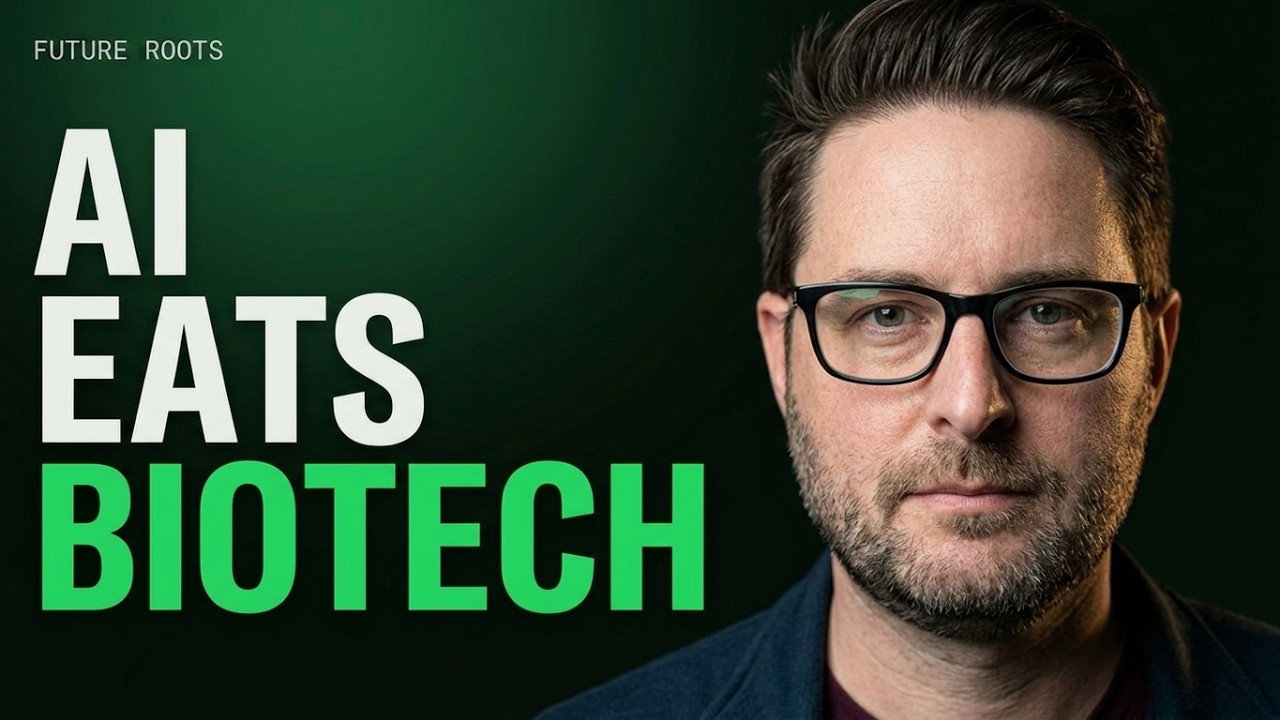
Future Roots · Conversation with Matthew Youngblut

Matthew Youngblut on Why AI Will Eat Biotech

Matthew Youngblut · Co-founder & CSO, Flock Bio

Watch on YouTube
Matthew Youngblut on Future Roots

Matthew Youngblut, Co-founder & CSO of Flock Bio, explains how his company builds custom high-throughput DNA libraries so customers can test millions or billions of variants at once. He describes the company's acceptance into Anthropic's life sciences verification program, and why responsibility and trust are central to using AI in biotech.

He tells the story of Flock Bio's pivot from mRNA bird flu vaccines to a services business, which reached profitability in its first year, and what he learned about founding teams and sales as a scientist. He also gives his prediction that AI will subsume biotech, and explains why the company funds its own projects in phage engineering and pediatric oncology.

In Matthew's words

“One of the main things moving forward in biotech, with the AI revolution, is how do you do it with responsibility? Because otherwise, you really erode trust. And once you lose trust, it's gone.”

Matthew Youngblut · 00:49

“Your founding team, the people that you start the company with, that's the real make or break. It's not necessarily your technology or your funding. It's the people that you work with.”

Matthew Youngblut · 06:20

“You can't AI a new gold mine, you can't AI a new coal mine, anything like that. But you can AI a new drug.”

Matthew Youngblut · 23:30

Key takeaways

  1. Using AI in biotech comes with a responsibility to screen for misuse, because trust, once lost, is gone.
  2. A biosecurity screening step that once looked like $10,000 to $20,000 of labor was built in under a day with newer AI models.
  3. Your founding team is the real make or break: look around the room, and if you see only yourself, you did it wrong.
  4. Flock Bio pivoted to services and reached profitability in its first year, helped by a team that had worked together for years.
  5. Matthew's view is that AI will subsume biotech because, unlike a gold mine, a new drug is something AI can help create.

Chapters

Questions people ask

Who is Matthew Youngblut?
Matthew Youngblut is Co-founder and Chief Science Officer of Flock Bio. He earned his PhD at the University of Wisconsin-Milwaukee and has worked in the Bay Area since a postdoc at Berkeley in 2013. He previously worked at Ginkgo Bioworks before co-founding Flock Bio.
What does Flock Bio do?
Flock Bio specializes in custom high-throughput molecular biology. It designs, assembles and quality-checks DNA libraries so customers can ask millions or billions of questions at once, for work such as better enzymes, antibodies, genetic medicines and crop traits. Matthew says its strongest traction is in cell and gene therapy, including custom barcoded libraries.
How did Flock Bio pivot?
Matthew says the company was founded to work on mRNA-based bird flu vaccines for chickens. After funding conditions for mRNA vaccines changed, it pivoted to a services offering, with a large sales component. He says it reached profitability in the first year after the pivot, helped by a team that had worked together for years.
What is the Anthropic life sciences verification program?
Matthew says Flock Bio was accepted into the program that week. It gives validated biotech companies access to frontier foundation models with fewer restrictions, but comes with responsibility around biosecurity. He says Flock Bio partnered with the European nonprofit IBBIS and now offers biosecurity screening routinely as part of its service.
Why does Matthew Youngblut say AI will eat biotech?
He argues that AI is already topping out in software, which he puts at about an $800 billion a year market, while therapeutics is about $1.8 trillion and growing. He says AI cannot create a new gold mine or coal mine, but it can help create a new drug or material. He adds that data sets that once took him weeks or months to analyze now take minutes to hours.

More conversations

Be a guest

Building what's next? Tell your story on Future Roots.

Forty-minute conversations with the investors, founders and leaders building the next twenty years.

Apply to be a guest